What Is AEO — and Why Your Website Needs to Show Up in AI Answers
written by @patty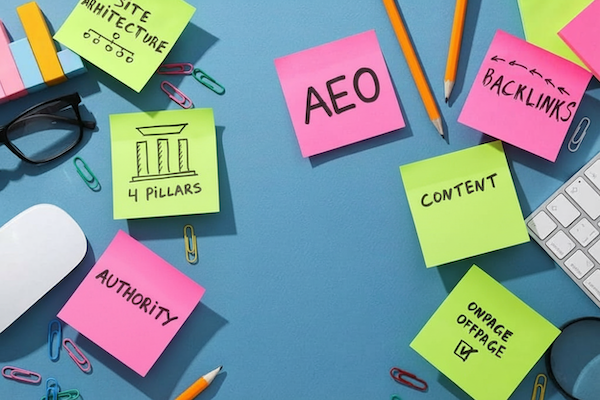
Think about the last time you needed a quick answer.
Did you open Google and scroll through ten blue links? Or did you just ask ChatGPT?
If you're honest, it's probably the second one more often than it used to be. And your customers are doing the exact same thing.
That shift — from searching to asking — is the single biggest change happening in how people find businesses online right now. And most small business websites aren't built for it.
That's what AEO is about.
What is AEO?
AEO stands for Answer Engine Optimization.
Traditional SEO — search engine optimization — was about ranking in Google so people would click through to your website. You optimized your pages, built backlinks, wrote blog posts, and hoped you showed up on page one.
AEO is different. It's about making sure AI tools like ChatGPT, Perplexity, Google's AI Overviews, and others can find your content, understand it, and repeat it back to someone who asked a relevant question — even if that person never visits your site at all.
Read that again. Even if they never visit your site.
That's the part that changes everything.
Why this matters more than you think
People are now shopping, comparing services, and making buying decisions through AI interfaces. Someone in Tulsa can open Perplexity right now and ask "who builds the fastest websites for small businesses in Tulsa" and get a synthesized answer pulled from across the web.
If your site doesn't have the right content written in the right way, you won't show up in that answer. Your competitor might.
This isn't a future problem. It's a right now problem.
I know this firsthand. I ran my own site through Perplexity recently and asked how Creative Pea shows up. The feedback was clear — the expertise was implied but not stated plainly enough for AI to pull and repeat. The information was there, but buried in visuals and animations that AI tools can't read.
That's a content clarity problem. And it's fixable.
The 4 pillars of AEO
I've been digging into this from a few directions — including a really good episode of the Profitable Web Designer podcast hosted by Shannon Mattern, where she sat down with conversion designer Gigi Davarashvili of One6Creative, and this breakdown from Renegade Marketing that lays out the framework clearly. These 4 pillars keep coming up across the industry because they work. Here's what actually moves the needle.
1. Create content that directly answers questions
AI engines are looking for direct, specific answers to the questions people are actually asking.
That means FAQ sections aren't optional anymore — they're one of the most powerful things on your site. Not the generic "how long does it take" stuff either. Real questions your clients ask. Phrased the way they'd actually say them.
Instead of: We offer web design services for small businesses. Try: Looking for a web designer who builds fast, custom sites for small businesses in Tulsa? Here's how we work.
The second version answers a question. AI tools love that. Humans do too.
2. Expand and enrich your content
A portfolio page full of pretty images and two sentences per project is not enough anymore.
AI needs words. It needs context. It needs specifics.
That means your case studies need to go deeper — what was the problem, what did you build, what happened after. Your service pages need to explain not just what you do but why it matters, who it's for, and what results people can expect.
This isn't just for AI either. Richer content builds trust with human visitors at the same time. It's a double win.
3. Prioritize clarity over creativity in your CTAs
This one surprised me but makes complete sense once you hear it.
Vague, poetic calls to action confuse AI tools. If your button says "Let's Grow Together" — an AI trying to understand your site doesn't know what that means. Is that a purchase? A contact form? A newsletter signup?
AI is a machine. It looks for clarity.
"Book a Free Strategy Call" tells AI — and your visitor — exactly what happens next. "Start Your Journey With Us" does not.
Go through your site and ask: if an AI read this, would it know what you want visitors to do? If the answer is no, rewrite it.
4. Build authority and trust signals
AI tools prioritize sources they consider authoritative and trustworthy. That means your site needs to demonstrate expertise and credibility — not just claim it.
Things that actually build authority for AEO:
- A detailed About page with specific credentials and real experience — not just "I'm passionate about helping businesses grow"
- Testimonials with specifics — "our site went from 4 seconds to under 1 second and our bounce rate dropped 40%" beats "great to work with!"
- Case studies with measurable outcomes
- Blog content that goes deep on topics you actually know
- Clear business details — name, location, contact info, service area
- External validation — press mentions, speaking gigs, podcast appearances
The through line is specificity. Vague content doesn't get recommended. Specific, credible content does.
The thing nobody is saying out loud
Your website might already have all this information. The problem might just be that it's not written down in plain, crawlable text.
If your speed stats live inside an animation, AI can't read them. If your process lives inside a slider, AI can't read it. If your credibility signals are embedded in a graphic, AI can't read them.
This is why performance-built, text-forward sites have a natural AEO advantage. Clean HTML, properly structured content, no JavaScript-dependent rendering — all of it makes your site easier for AI to parse and repeat.
Fast sites aren't just better for humans. They're better for AI too.
So what do you do with this?
Start with your own audit. Open ChatGPT or Perplexity and ask about your business directly. Ask it to summarize your homepage. Ask it who the best option is in your industry in your city.
See what comes back.
Whatever's missing from that answer — that's your content gap list. And most of the time it's not a redesign problem. It's a writing problem. The right words, in the right places, in plain readable text.
That's what AEO optimization is at its core. Not a technical overhaul. A content clarity project.
Come find me on Instagram @creativepea and let's talk about it. No bots, no pitch — just me. Whether you're a fellow designer nerding out on where search is heading, a business owner trying to figure out what this means for your site, or just someone who likes staying ahead of the curve — my DMs are open. I genuinely love these conversations.